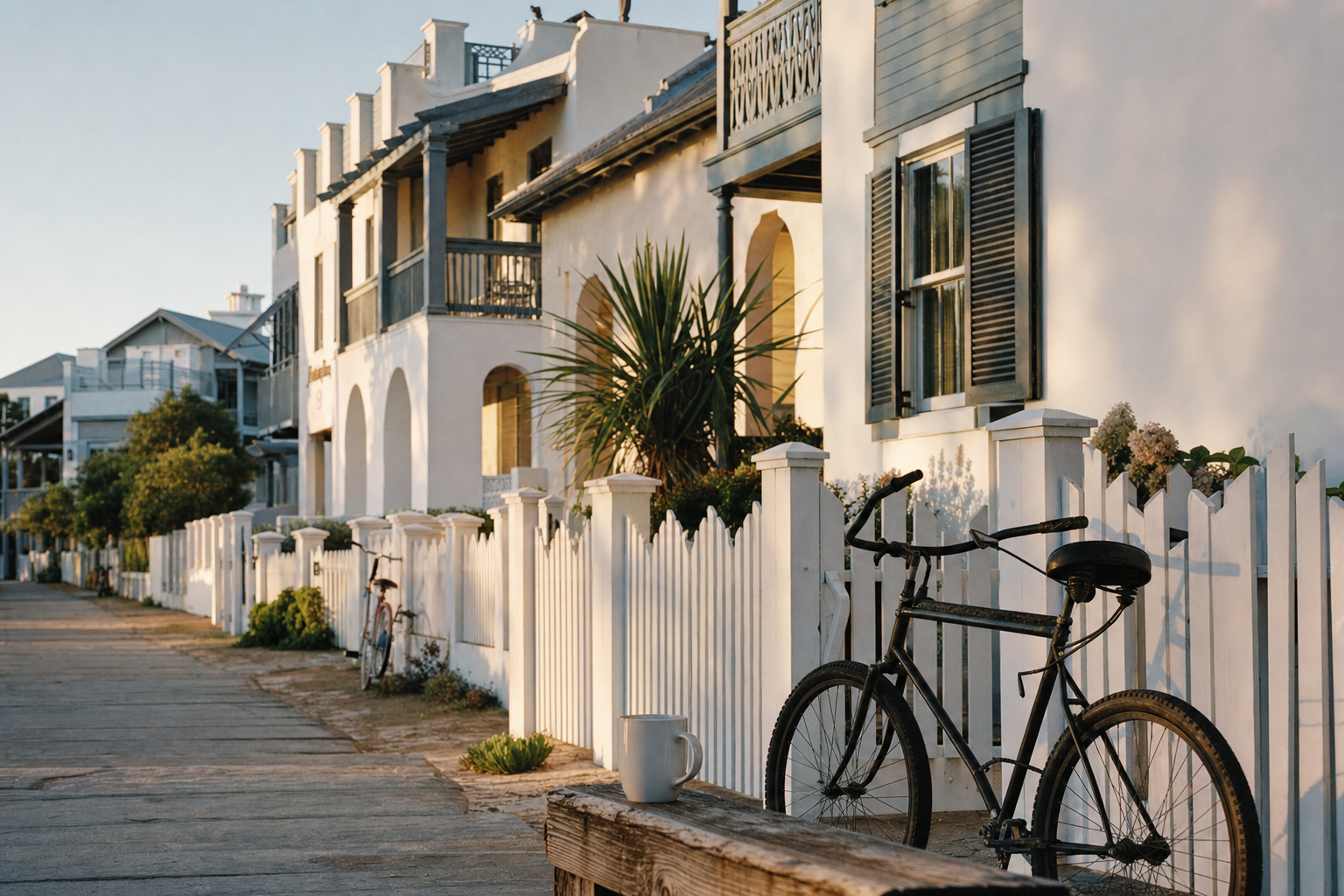
There are more independently owned bookstores on Florida’s 30A highway than there are chain hotels — a ratio that makes it an anomaly among American seaside destinations, and one that quietly signals the area’s priorities: local, considered, and unbranded by design.
The Case for 30A: What’s Changed?

Until recently, the Florida 30A luxury travel experience was a well-kept regional secret. For years, the stretch from Dune Allen to Inlet Beach was where Atlanta families stashed their woven baskets and Louisville architects came to sketch, but you would rarely hear it mentioned in a New York dinner party conversation. That is no longer the case. There is now a direct flight from LaGuardia to Panama City Beach and, on a recent weekday morning, the coffee line at Black Bear Bread Co. held three distinct accents, none of them Southern.
What’s interesting about 30A’s ascent isn’t just its broader appeal, but the deliberate way the area has resisted the normal slide into excess. There is no Four Seasons tucked behind the dunes, and the most audacious thing about the Seaside amphitheater is that it remains open to everyone, all of the time. Planners have enforced strict density caps—no buildings over four stories, no neon, and a preference for boardwalk over blacktop. The result is a place where you notice the absence of what is usually sold as luxury: valets, uniformed greeters, the dining room treadmill of flash and spectacle.
The demographic has shifted accordingly. The clatter of spring breakers is a distant memory, replaced by a more muted crowd: design professionals on midweek escapes, chefs with a few weeks between kitchens, couples who know the difference between Rosemary Beach architecture and the simulacra of any planned community. You see them most often on bikes, basket loaded with groceries, or standing in breezy clusters at the farmers’ stands in Seagrove. They talk, but they rarely broadcast.
Infrastructure has kept step, quietly. New bike paths connect Grayton Beach to Alys, local shuttles now run late enough for post-dinner returns, and noise ordinances mean you can actually hear the crickets if you’re out past ten. The effect isn’t sterile so much as intentional—less a retreat from activity, more a framework for conviviality that stretches into the evening. I’ve watched two chefs, both visiting, both strangers, settle into a real conversation at Black Bear Bread Co. over filter coffee and kouign-amann. No one tried to pitch, selfie, or sell. The interaction was as unfussy as the setting.
What’s present is often more telling than what’s absent. Families cycle to get bread rather than summon a delivery. Dinner conversations run past dusk because there is nowhere to be but here. There is a sense, not of lack, but of enough.
Design in Harmony: Architectural Intentionality
New Urbanism is a term that means nothing until you have walked its streets. On 30A, it translates to towns like Seaside and Rosemary Beach where the human scale is not a marketing pitch but a lived reality. Streets are narrow, front porches are deep, and every few blocks the pattern breaks with a green or a small plaza. No house is out of place, but neither does it feel like a movie set.
Rosemary Beach architecture is the result of a code, yes, but also of a culture that prizes simplicity. Wood siding in subdued colors. Metal roofs that age in the salt air. The palette runs from oyster to ecru, with the occasional green shutter. There is a rhythm to it that avoids the rigid repetition of a resort. Houses face the street, porches invite a slow drift of conversation from public to private. Walking from one square to another, you are more aware of the scent of rosemary or the click of a bike gear than of any forced aesthetic.
The counterargument is that all this harmony could breed monotony. In practice, the enforced cohesion is a form of hospitality. There is no visual noise; nothing asks more of your attention than it deserves. Stand at the central amphitheater in Seaside and you can walk to dinner, a bookshop, or the sea in three minutes. None of it is accidental, and that is the point.
Provisioned, Not Posh: Rethinking Food and Gathering
If you come to 30A seeking the sort of restaurant that is described in hushed tones by international food writers, you might be disappointed. There are no temples of gastronomy here. What you find instead is something more elemental: shucked oysters at Shunk Gulley where the Gulf wind threatens to scatter your napkin, a wedge of Spanish mackerel that arrived with the fisherman’s truck that morning, a loaf of sourdough at Blue Mountain Bakery that, frankly, beats most big city equivalents.
Market culture is the backbone. Modica Market in Seaside has been supplying both residents and vacationing families since long before "local food" became a catchphrase. The recorded tab at Modica on a Friday morning: two baguettes, Florida strawberries, a wedge of cheese that traveled no further than you did. The shelves carry as many regional sauces and honeys as you’d find at a Hill Country farmstand, and the staff will ask how your week has been. Not out of training, but habit.
Cocktail culture is better than it needs to be. At NEAT in Alys Beach, a Negroni arrives cold and precise, the orange peel expressing itself without drama. The room is full, but the energy is dialed low—the space built for conversation, not spectacle. It is possible to sit an hour and hear nothing but the low hum of friends and the clink of glass.
The thesis, if one exists, is that true luxury here is simply being provisioned: the right food at the right level, the right bottle opened at the right time, and enough left for the next guest. Scarcity isn’t manufactured here; sufficiency is quietly maintained.

The Social Scene: Subtle Signals, Real Belonging
Status on 30A isn’t declared. It’s recognized. To secure a last-minute table at Café Thirty-A, you’re better off knowing the bartender’s dog’s name than the owner’s Instagram handle. The social code is practical, not performative: linen shorts, a hat that’s seen years of sun, and a willingness to return a borrowed cake pan. If you linger on a porch after dark, it’s because you were invited—and because there is no velvet rope to cross, only a screen door.
On a busy weekend night, the only visible symbol of arrival is sand on your feet after walking home from Grayton Beach State Park. In a place built on quiet participation, this is enough.
Why 30A Is the Next Canonical Escape
30A is not an alternative to high-gloss resorts; it is their antithesis. There is no spa menu, but there is a working knowledge of tides. The Florida 30A luxury travel experience is shaped by restraint, by the absence of flash, and by a sense that enough is as good as a feast. This is not nostalgia; it is a kind of future-proofing.
Architects and developers now cite 30A in slide decks as a model for American beach town design that carries weight beyond Florida. Travelers use it as shorthand: 'We want a Seaside vibe.' It’s a place where walkability, porch parties, and the expectation of local food are not revolutionary ideas but table stakes. Walk a block in Alys Beach and you see what happens when design codes are enforced with purpose rather than paranoia.
There are risks to being canonical. Overexposure is always a threat, as anyone who has tried to park in Seaside on July 4th will attest. But the area is surprisingly adept at policing its own identity. Residents care less about property values than about who is invited to the potluck. The biggest controversy in recent years was over the right to keep beach chair vendors off public sand. The area’s greatest asset is an informal but unyielding sense of stewardship.
Conviviality is the default mode. Environmental stewardship is not a talking point, but a set of quietly enforced norms—reusable bags, no plastic straws, the expectation that you’ll leave the beach cleaner than you found it. These are not gestures for Instagram; they are the price of entry. In 30A, the line between resident and guest blurs. To return is to participate, not just consume.
To have truly arrived on 30A is not to be recognized at a restaurant or to own the right house, but to realize how little you actually need to feel at ease. The absence of a doorman is a virtue; the presence of neighbors who remember your name, year after year, is the real status. If the next wave of luxury travel is about collaboration—between planners, residents, and guests—then 30A is both the current standard and the challenge.
True luxury on 30A is not what you can buy, but what you can live without.