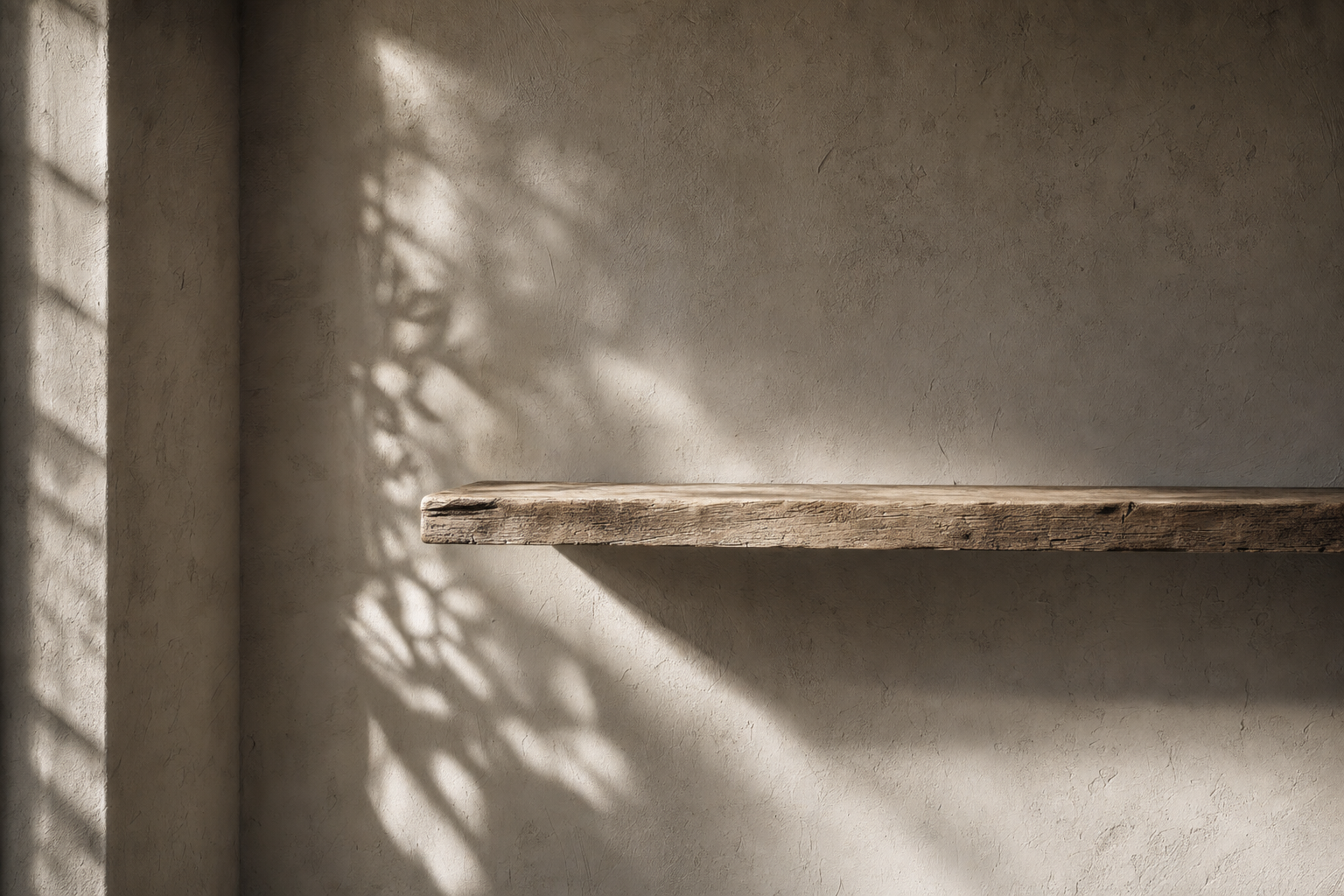
The morning light filters softly through a wide-set window, landing with gentle reverence on a single, unadorned wooden shelf. Its grain stands stark against the bare wall, drawing attention to its emptiness and inviting thoughts of what could be, rather than what is. In the quietude of this space, the shelf does not clamor for attention with colorful knick-knacks or an artful arrangement of books. Instead, its emptiness resonates, setting the stage for a narrative that is as much about absence as it is about presence.
Silence in the Object
The charm of minimalist design principles lies not in the scantiness of objects, but in the way these spaces orchestrate silence. The art of empty shelves is part of this design theology. It is a deliberate non-declaration, a choice to let the void remain, to have the eye trace the unfettered line of the shelf itself rather than the silhouettes of what might clutter it. Here, emptiness becomes a participant in the room, not merely an absence but an element that invites reflection. A room that holds its breath can be a room that encourages you to breathe.
What is crucial here is understanding how the significance of empty space draws from centuries of contemplation on absence. From Zen gardens with their expanse of raked gravel to the Shaker ethos of simplicity, the aesthetic of emptiness reveals itself as neither austere nor barren. It whispers stories untold and possibilities unconsidered. Silence, captured in the curve of a bowl or the line of a chair, asserts itself not as vacancy, but a presence defined by its potential.
The Echo of Use
A shelf unburdened by the presence of objects can suggest far more than it seemingly neglects to show. It holds the echo of its potential use, much like a stage devoid of actors tells a silent tale of stories that might yet unfold. This is luxury through absence—a contemplative home decor principle that elevates the suggestion over the proclamation, crafting luxury from the intonation rather than the overt performance.
To live amongst objects is to invite those physical manifestations to impress upon one’s experience. But to place objects with such restraint that empty shelves remain permits the room to resonate with a different kind of life—a lifestyle less tethered to the material and more attuned to its shadow, a life that honors possibilities over certainties.
Emptiness as Abundance
To cultivate a room with empty spaces is to acknowledge that completeness is not an accumulation but a subtraction, a distillation of life to its essence. In freeing ourselves from clutter, the mind is likewise liberated from endless distraction. It is in this restraint where one discovers abundance, where the room itself becomes a canvas upon which the light might pause, casting shadows that offer more to contemplate than the most ornate of vases.
An empty shelf is not merely a void; it is a welcome to the unexpected, a space that waits. One might reflect on the words of Bachelard: “The poetic image, in its newness, opens a future to the past.” This poetic image of the empty shelf gestures towards what could be born from within its emptiness.
“Absence is the invitation to possibility.”
Navigating the Balance
Yet, in this pursuit of emptiness, there is a balance to be struck. The Paradox of the Empty Shelf reminds us that while absence can be abundant, it is an aesthetic demanding care and intention. A room with too little could become austere, but a room with just the right measure of emptiness vibrates with its own vitality, whispering of a life that chooses its companions carefully.
Each choice within our living spaces becomes a statement, not of what we are hiding, but of what we allow to breathe. The shelter of an empty shelf crafts a place for new stories, moments, and reflections to inhabit the silence.
The Quiet Embrace
We are, ultimately, creatures of complex longings. The art of the empty shelf offers a gentle signal amidst the cacophony—an invitation to pause and recognize abundance in what remains unsaid. Standing before the open expanse of the shelf, we are encouraged to lay down our burdens, to engage not with another possession, but with the nuanced grace of our own thoughts.
In embracing the paradox of the empty shelf, we embrace a life not crowded with more, but enriched by less. And in this gentle acknowledgment, there is a profound recognition that we have arrived not at an ending, but perhaps at a true beginning, quiet and waiting.